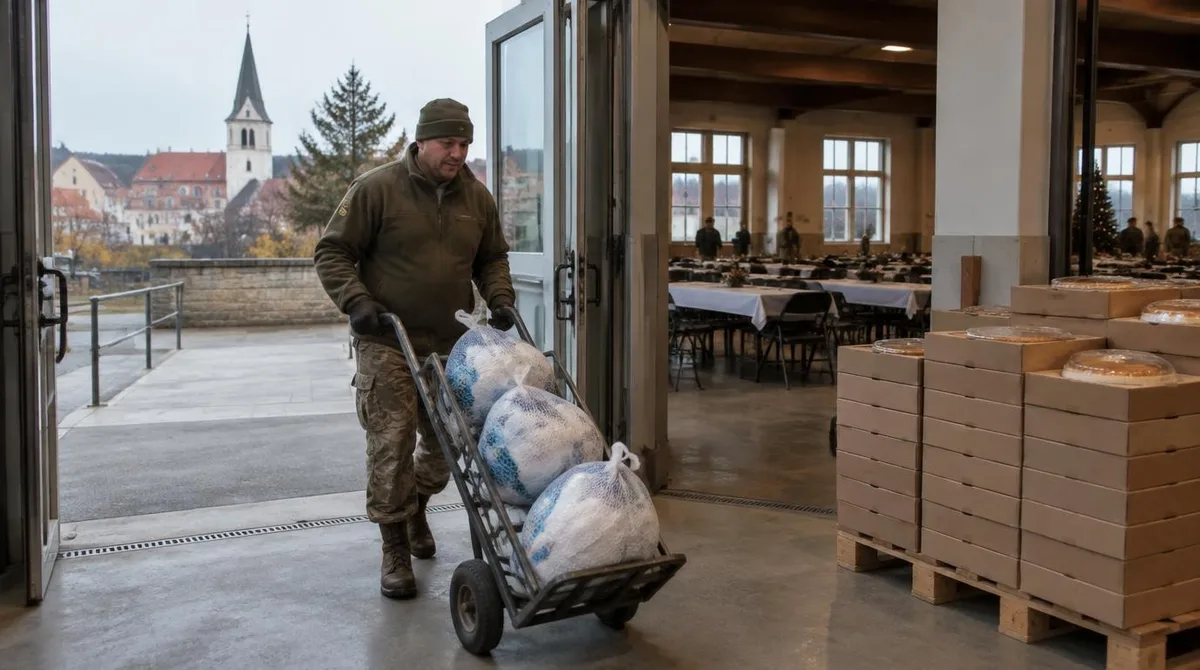
The Defense Logistics Agency moved more than 585,000 pounds of food for Thanksgiving 2026, including 193,459 pounds of turkey and 8,018 cases of pies and cakes, according to a Nov. 19 DLA news release cited by Military.com. The number matters less as a holiday story than as a read on force posture: DLA's totals rise and fall with where troops are stationed. This year's figure sits well above 2025's 380,000 pounds but below the nearly 700,000 pounds of 2024.
The meal itself is the visible end of a supply chain that begins in spring. Military branches send DLA their holiday requests in spring, staff start gathering ingredients in April, and prime vendors — the contracted distributors that supply military dining facilities — need a 90- to 120-day lead time to get products overseas. That means the turkey on a tray in Germany, Japan or the Middle East was ordered before most Americans had lit a Memorial Day grill. For readers who follow defense news, the holiday release is one of the few moments the scale of routine troop feeding becomes public. Readers following this should also see VA Claim Evidence: What Records You Need and How to Get Them.
Why the 2026 Numbers Moved Up
DLA's yearly totals track stationing, not appetite. The agency reported more than 360,000 pounds in 2023. The total jumped to nearly 700,000 pounds in 2024, which Robin Whaley, chief of DLA Troop Support Subsistence's Customer Operations Division, attributed at the time to a larger military presence in Europe. It fell back to more than 380,000 pounds in 2025, when the order included 152,626 pounds of turkey and 38,081 pounds of shrimp.
This year's 585,000 pounds sits between those two years. The 2026 order also included 162,079 pounds of beef, 128,488 pounds of crab, lobster and shrimp, 86,938 pounds of ham, about 14,896 pounds of whole pigs, 7,158 cans of sweet potatoes and 1,321 cases of eggnog. One caution the agency's own record supplies: DLA's yearly releases do not always count the same items, so year-over-year comparisons are rough. A reader comparing 2025 to 2026 is comparing slightly different baskets. We covered a connected angle in Applying for VA Disability Benefits Years After Service: A Guide. We covered a connected angle in Applying for VA Disability Benefits Years After Service: A Guide.
What the Whole Pigs Line Means
The most concrete signal in the 2026 order is a new line item: about 14,896 pounds of whole pigs, which Military.com describes as new to the menu this year. The release does not say where the pigs went, so any further reading would be speculation.
The Hard Part: Ships at Sea
The logistics story of 2026 is not the tonnage but the Navy deliveries. Whaley said this year's deliveries to Navy vessels were complicated by operational commitments, global conflicts, host-nation clearance rules, delayed and heat-damaged containers and transportation limits at multiple ports. DLA worked with the Navy on plans tailored to each ship's location and schedule.
Those workarounds are instructive, because they show the fallback options when the normal pipeline fails:
- Buying from alternate prime vendors in the United States.
- Moving products among overseas vendors.
- Ship-to-ship transfers at sea.
- Multiple airlifts and rerouting deliveries as conditions changed.
"We worked closely with U.S. Transportation Command to coordinate and execute several airlifts to meet customer requirements," said Lourdes Valentin, DLA Troop Support's director of subsistence supplier operations, per the release. A holiday meal cannot be late; the calendar does not move.
Why a 120-Day Lead Time Matters
The timeline discipline is the quiet lesson of the piece. High-volume items such as turkeys typically begin arriving at overseas locations in October. Shorter shelf-life items cannot survive the longest shipping routes: in West Africa, DLA has shipped turkeys on a trek of up to 120 days and flown dairy and produce separately from Ramstein Air Base in Germany. The system therefore splits into two channels — slow surface freight for durable goods, fast air for anything perishable — and the split is planned months ahead, not improvised.
DLA Troop Support also coordinates with regional commands in Europe and the Indo-Pacific, service headquarters and the units being supplied to account for demand, delivery schedules, storage limits and changing operational conditions. That coordination layer is what absorbs the surprises Whaley described. When containers are delayed or heat-damaged, the fix is a re-plan at the command level, not a phone call to a grocery store.
The Tradition Behind the Operation
The holiday meal is a long-running Army tradition, traced through more than 150 years by a staff Army historian. A New York Times dispatch dated Dec. 1, 1864, praised the turkey, goose and duck served to Union troops under Sheridan and called it a "real old-fashioned Thanksgiving dinner." At Fort Sill in 1874, a correspondent reported a hunting party of 12 men brought 156 turkeys back to the canteen, and officers added 60 more turkeys, five deer, two wildcats and a bear.
World War II shows the same pattern at national scale. In 1944, the War Food Administration limited civilian turkey sales until the Quartermaster Corps' needs were met. By 1945, Under Secretary of War Robert P. Patterson wrote that Army food requirements made up 12 percent of the nation's total food supply. The 2026 operation is smaller in kind, not in structure: a fixed calendar, a long lead time and a supply chain that bends around operational conditions.
What to Watch Next
The useful next data point is the 2027 order. If the whole-pig line item returns, it suggests a durable demand change rather than a one-year experiment. If the totals climb back toward 700,000 pounds, the driver will most likely again be stationing, not menu planning. And the Navy delivery workarounds — alternate vendors, ship-to-ship transfers, airlifts — are worth watching as a gauge of how much friction the global shipping environment is adding to routine troop support. For more on how defense programs and benefits connect, see the site's government news coverage.